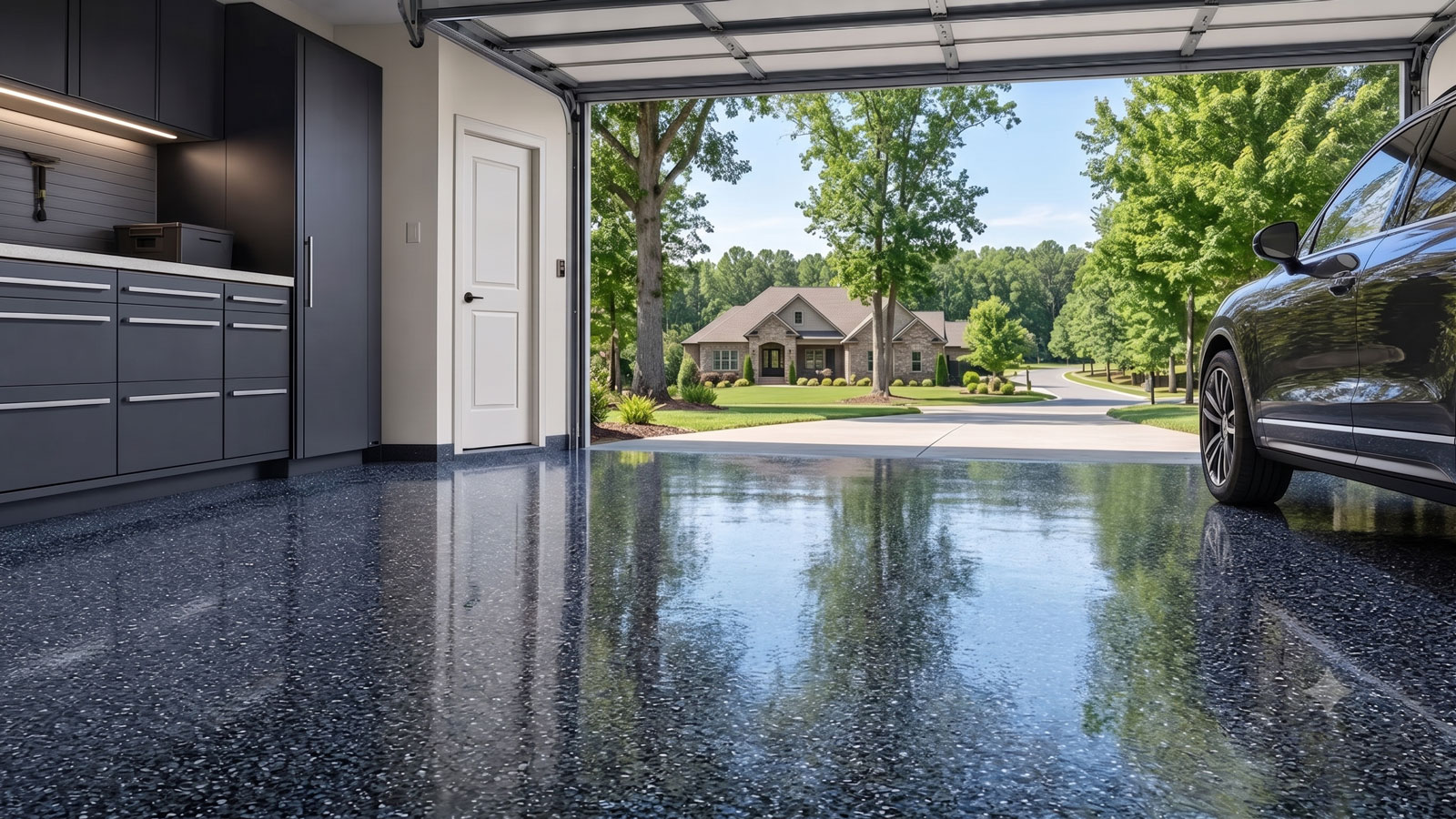
Garage Floor Coating in Hilliard, OH
Floor Coating Services in Hilliard, OH
Hilliard's garage stock reflects three clear growth eras: the older railroad community, major subdivision growth in the 1950s and another expansion cycle after I-270 arrived in the 1980s. An Old Hilliard garage may have later additions, paint or repours, while a mid-century floor can have decades of patches and repairs. Newer western slabs can look clean yet still carry builder treatments.
Western Hilliard also sits near the Big Darby watershed and other drainage corridors, while former farmland has been converted to streets, roofs and driveways. Neighborhood detention and swales help manage runoff, but they do not guarantee every driveway sheds water away from the garage. Threshold pooling and downspout discharge still need a property-level check.
The coating plan should therefore separate concrete history from drainage. Older paint, patches and mixed pours require different work from curing compounds, sealers and control joints on younger floors, and neither issue should be confused with an exterior runoff problem. That separation is especially useful in a city where three development eras can sit only a few miles apart.
Local Market Insight
Hilliard has three especially visible garage-concrete eras: the older railroad core, large 1950s subdivision growth, and later I-270-era expansion. Western development also places more attention on subdivision grading, detention, and runoff as farmland has become paved neighborhoods.
What Affects the Cost of Garage Floor Coating in Hilliard?
Hilliard's railroad core, 1950s subdivisions and later I-270-era growth create several garage-concrete generations. Old paint, repairs and later additions can drive preparation in established areas; builder treatments and control joints can dominate newer floors. Western runoff, lot grading, winter residue and multi-bay layouts further affect project scope.
Development-era slab history
Hilliard began as a railroad community in the early 1850s and incorporated in 1869 with only about 280 residents. Three large subdivisions drove a major 1950s growth wave, and I-270 brought another expansion cycle in the 1980s, creating several distinct generations of suburban garage concrete. The preparation should follow the actual slab generation rather than the age of the city name.
Creek, river, and stormwater context
Hilliard sits on the western Columbus edge near the Big Darby watershed and other local drainage corridors. As farmland became subdivisions, roofs, roads, and driveways increased runoff, making detention, swales, and lot grading important even on relatively new properties. Property-level drainage evidence matters more than broad proximity to a waterway.
Existing coatings and construction treatments
Floor paint, DIY epoxy, clear sealer, curing compound, adhesive, and builder residue can all interfere with adhesion and may require full mechanical removal.
Cracks, joints, and mixed pours
Stable cracks, control joints, repours, utility cuts, chipped edges, and additions should be evaluated before full-surface grinding so repairs match the concrete condition.
Four-season vehicle residue
Snowmelt, salt, grit, and central-Ohio freeze-thaw cycles make strong adhesion and easy cleanup valuable across both mid-century and newer garages.
Garage layout and return-to-service
Steps, stem walls, cabinets, storage alcoves, multiple bays, traction preference, and how quickly vehicles must return can change labor, materials, and system choice.
Call for a clear, project-specific estimate — or request one online.
Hilliard's railroad core, 1950s subdivisions, and I-270 growth created three slab eras
The city's strongest residential growth did not occur in one period. An older in-town garage, a mid-century suburban floor, and a newer outer-Hilliard multi-bay slab can all require different preparation even when the coating system selected at the end is similar.
Old Hilliard and mid-century neighborhoods may have paint, stable cracks, patching, or later garage additions, while newer western development more often brings larger attached garages with young concrete and builder treatments.
A useful Hilliard inspection should identify which slab era is actually present, where previous coatings or repairs remain, and whether newer concrete carries sealers, curing compounds, or smooth finishes that need mechanical profiling.
Western growth makes runoff a development-era issue as well as a weather issue
New development changes how rainfall reaches ditches, detention systems, and regional watersheds such as Big Darby. At a specific garage, inspect the apron, swales, downspouts, and street drainage before treating recurring threshold water as a floor-coating problem.
On the western edge, the Big Darby watershed and newer subdivision drainage systems make driveway pitch, swales, detention, and downspout routing worth checking at the specific home rather than relying on broad weather assumptions.
If stormwater moves away from the garage, the project can stay focused on concrete preparation and use. If the apron or threshold regularly ponds, that drainage issue deserves its own correction. Hilliard homeowners should also distinguish neighborhood drainage design from what happens at the individual door. Swales and detention may manage stormwater at a larger scale, yet a driveway can still concentrate water at one garage threshold. Likewise, an older house may have a newer garage slab. Looking for actual runoff, joints, repours, paint and patch lines gives a more useful project scope than relying on subdivision age alone. That same distinction matters in Hilliard's western growth areas. Neighborhood detention and swales may manage runoff broadly, but the garage door is still a local low point on some lots. Inside the garage, a later addition or a builder-treated newer slab can create preparation needs that have nothing to do with the age of the surrounding subdivision.
Before coating a Hilliard garage
- Does the slab appear original, added later, or made from multiple concrete pours?
- Is paint, sealer, curing compound, adhesive, or an old coating present?
- Are cracks, patches, pitting, chipped edges, or utility cuts visible?
- Does the driveway or surrounding grade send rain or snowmelt toward the door?
- Are water marks, mineral deposits, slow-drying areas, or previous coating failures present?
- Where do road salt, grit, wet tires, and seasonal debris normally collect?
- Is the garage primarily parking, household entry, storage, workshop, recreation, or mixed use?
Hilliard Garage Floor Coating FAQs
How do Old Hilliard garages differ from newer western Hilliard garages?
Older garages are more likely to have paint, cracks, patches, additions, or mixed pours. Newer garages more often have smooth finishes, curing compounds, sealers, builder patching, and larger multi-bay layouts.
Why is subdivision drainage relevant in western Hilliard?
Recent development converted former farmland into roofs, roads, and driveways. Swales, detention systems, and driveway grade can therefore affect whether stormwater reaches the garage threshold.
Does a clean-looking newer Hilliard slab still need grinding?
Yes. A clean appearance does not rule out curing compounds, sealers, dense finishes, or construction residue that can interfere with adhesion.
What tends to add prep on a mid-century Hilliard garage?
Old coatings, stable cracks, patch compounds, repoured sections, edge deterioration, and contamination can all increase removal or repair work.
Why can a newer western Hilliard garage still need substantial surface preparation?
A newer slab can contain curing compounds, sealers, smooth finishes and builder repairs even when it has little visible wear. Those materials need to be identified and mechanically addressed before a coating can reliably bond to the concrete.
Hilliard Neighborhoods & Local Context
Phone Quote Line
Speak with a floor coating specialist about your project and get a realistic estimate range.
(380) 324-0500Typical Project Cost
$3,000–$5,500
Typical range for a two-car garage. Final pricing depends on floor size, concrete condition, prep work, coating type, and finish options.
Helpful Guides