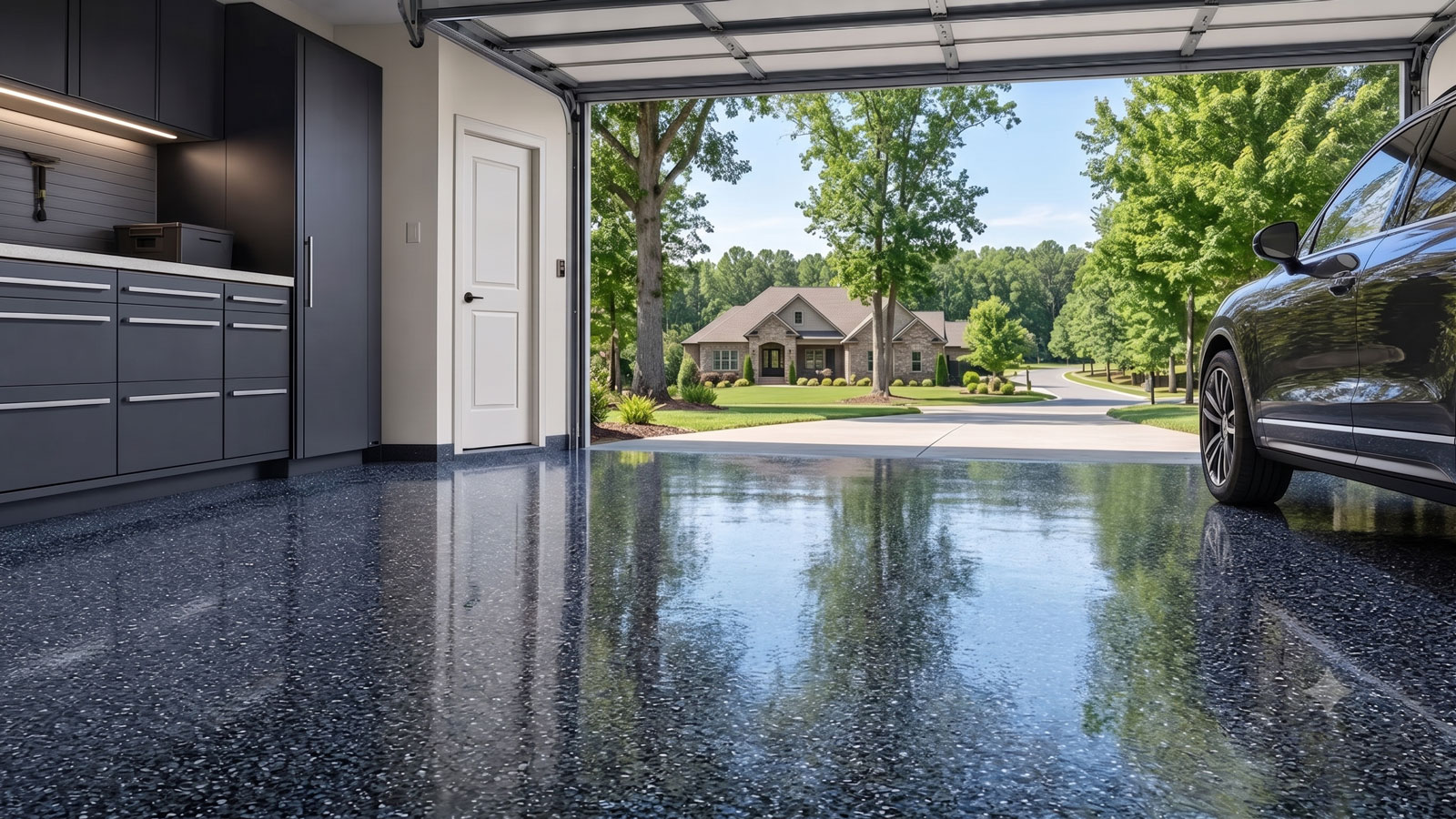
Garage Floor Coating in Powell, OH
Floor Coating Services in Powell, OH
Powell grew from a small nineteenth-century village into a suburb of more than 14,000 people after major residential expansion began in the 1980s. Much of today's garage stock is therefore comparatively young, although established properties can still contain later additions or repoured floors. New concrete is not automatically coating-ready; sealers, curing compounds, dense finishes and builder patches can still interfere with adhesion.
The city sits in rolling highlands between the Scioto and Olentangy valleys and manages a mapped stormwater system. Winter thaw is especially useful to watch because snow and ice can block inlets and create local pooling. Even with modern public infrastructure, a sloped driveway can send rain or meltwater toward the garage door.
For a coating project, the practical checks are surface treatment, joints and repairs on the slab, plus actual threshold runoff at the property. Those findings matter more than assuming a newer Powell neighborhood has either trouble-free drainage or trouble-free concrete. That property-level check is especially important on rolling lots where the same storm can drain very differently from one driveway to the next.
Local Market Insight
Powell combines a small historic village with rapid suburban growth beginning in the 1980s. Rolling terrain between the Scioto and Olentangy valleys, plus winter-thaw drainage, makes the driveway and storm inlets especially useful clues when evaluating a garage project.
What Affects the Cost of Garage Floor Coating in Powell?
Powell's rapid suburban growth means many projects start with younger attached-garage concrete, while established village properties can have older or later-added floors. Builder treatments, joints, repairs, rolling driveway grades, winter thaw and multi-bay layouts can each alter preparation and scheduling before the coating system is chosen.
Development-era slab history
Powell had a settlement by 1813, was renamed for Judge Thomas Powell in 1857, and became a municipality in 1947 when fewer than 400 residents lived there. Population stayed relatively stable until the early 1980s, when Columbus-region residential growth transformed the small village into a suburb of more than 14,000 people. The preparation should follow the actual slab generation rather than the age of the city name.
Creek, river, and stormwater context
Powell sits in rolling highlands between the Scioto and Olentangy River valleys, and the city manages a mapped stormwater system of catch basins, manholes, inlets, and storm mains. Winter thaw is a practical local issue because snow and ice can block inlets and create localized pooling. Property-level drainage evidence matters more than broad proximity to a waterway.
Existing coatings and construction treatments
Floor paint, DIY epoxy, clear sealer, curing compound, adhesive, and builder residue can all interfere with adhesion and may require full mechanical removal.
Cracks, joints, and mixed pours
Stable cracks, control joints, repours, utility cuts, chipped edges, and additions should be evaluated before full-surface grinding so repairs match the concrete condition.
Four-season vehicle residue
Snow and ice can block drainage in winter, and meltwater mixed with road salt can concentrate at the apron before spring storms become the dominant runoff concern.
Garage layout and return-to-service
Steps, stem walls, cabinets, storage alcoves, multiple bays, traction preference, and how quickly vehicles must return can change labor, materials, and system choice.
Call for a clear, project-specific estimate — or request one online.
Powell's small-village history and 1980s growth wave create a clear old-versus-new split
For most of its history Powell was a very small community; metropolitan residential development accelerated only in the late twentieth century. That means many current garages are comparatively young, but a historic-core property can have a much longer and more complicated surface history.
Near the older Powell core, garages may be detached, added later, or altered over time. Much of the city’s newer housing instead presents younger attached slabs where sealers, curing products, control joints, and builder repairs are more common.
The preparation plan should follow the physical floor: identify coatings, slab transitions, repairs, surface treatments, and contamination rather than assuming that a newer-looking neighborhood means minimal work.
Rolling terrain and winter thaw make the driveway part of the inspection
Powell's position between river valleys produces varied lot grades, while the city actively clears storm drains during thawing conditions to reduce localized flooding. The garage-scale question is whether meltwater or stormwater actually reaches and lingers at the door.
Powell’s rolling terrain and mapped stormwater system make lot-specific drainage important, especially during snow and ice melt when blocked inlets or low spots can create temporary pooling near driveways.
If the driveway and inlets move water away cleanly, the coating project can remain focused on surface preparation and finish. Recurring ponding at the apron or threshold should be handled separately. For Powell homeowners, the useful distinction is between public drainage context and the actual path water takes on the lot. Catch basins and storm mains manage neighborhood runoff, but they do not change the pitch of an individual driveway. The same property-level thinking applies to concrete: a newer home can still have sealers or curing products that demand significant grinding, while an older garage may have been repoured more recently. Powell's terrain makes this especially visible during snowmelt and heavy rain. A homeowner can learn more by watching where water travels across the driveway and apron than by relying on a neighborhood-wide assumption. Inside, joint layout, builder treatments and garage additions should be evaluated independently so drainage and concrete preparation do not get confused.
Before coating a Powell garage
- Does the slab appear original, added later, or made from multiple concrete pours?
- Is paint, sealer, curing compound, adhesive, or an old coating present?
- Are cracks, patches, pitting, chipped edges, or utility cuts visible?
- Does the driveway or surrounding grade send rain or snowmelt toward the door?
- Are water marks, mineral deposits, slow-drying areas, or previous coating failures present?
- Where do road salt, grit, wet tires, and seasonal debris normally collect?
- Is the garage primarily parking, household entry, storage, workshop, recreation, or mixed use?
Powell Garage Floor Coating FAQs
Why do Powell garages show such an old-versus-new split?
Powell remained a small village for generations before rapid suburban growth in the 1980s and after. Older properties may have later-added garages, while newer areas more often have young attached slabs.
Why does winter thaw matter for a Powell garage?
Snow and ice can block storm inlets and create temporary pooling. Watching the driveway and threshold during a thaw can reveal drainage issues that are not obvious in dry weather.
What should be checked on a newer Powell floor?
Look for curing compounds, clear sealers, smooth finishes, builder repairs, control joints, and construction residue that may need mechanical removal or profiling.
Can rolling terrain affect a Powell coating project?
Yes, indirectly. Driveway slope and lot grade can concentrate runoff at the garage door even when the slab itself is sound.
Why does Powell's rolling terrain matter even when the neighborhood has a modern storm system?
A sloped driveway can concentrate rain or snowmelt at the garage door even when public stormwater infrastructure is working properly. The installer should look at actual threshold pooling, downspout discharge and slab dampness rather than assume newer development eliminates runoff concerns.
Powell Neighborhoods & Local Context
Phone Quote Line
Speak with a floor coating specialist about your project and get a realistic estimate range.
(380) 324-0500Typical Project Cost
$3,000–$5,500
Typical range for a two-car garage. Final pricing depends on floor size, concrete condition, prep work, coating type, and finish options.
Helpful Guides